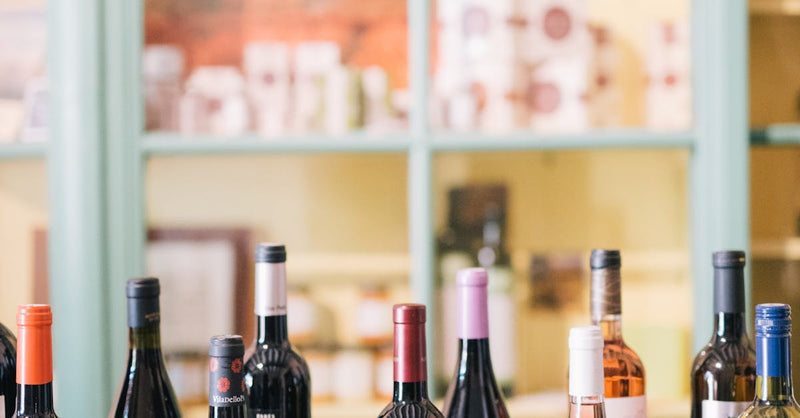

People ask, often, what the buying logic is. Why do we stock five different Pooley Rieslings but only one supermarket label of Spanish Tempranillo? Why are there forty Vedrenne liqueurs but no Jagermeister? Why do we sell Killik rum from Tasmania at $102 a bottle when you can get Bundaberg for $40?
The honest answer: every bottle on the Caravan list has to be a wine or spirit one of us would open at home. That's the filter. It's a small filter, and it cuts out about 95% of what's available in the Australian market. What gets through is the list.
Wine: small, family, place-driven
We stock the producers who farm their own grapes, run their own cellars, and put their family name on the label. That cuts out almost every supermarket label and most of the corporate Australian wine business. What it leaves is wineries like:
Pooley Wines in Tasmania's Coal River Valley. Founded in 1985 by Denis and Margaret Pooley; their granddaughter Anna Pooley is the current winemaker. Sixteen hectares at the original Cooinda Vale vineyard, plus the heritage-listed Belmont estate near Richmond. Named Halliday Wine Companion's Winery of the Year in 2023. We sell their Riesling, Pinot Noir, Chardonnay, Syrah, and Gewürztraminer — nine bottles in total from a single family producer because every release is worth drinking.
Lake Breeze Wines in Langhorne Creek, South Australia. The Follett family planted their first vines in the 1880s; the current generation runs it. They make Cabernet, Malbec, Pecorino, Chardonnay — the entry-level Bullant Cabernet Merlot ($19) is one of the best-value Australian reds we stock, and the Arthur's Reserve 2021 ($46) is the flagship.
Domaine Pichot in Vouvray. Four generations of organic Chenin Blanc — their Clos Saint Mathurin Brut 2023 ($37) is the sparkling we recommend more than any other on the list.
The pattern: real families, real vineyards, real continuity. We're suspicious of brands that exist on paper but not in a place.
Spirits: distillers who do one thing properly
The spirits half of the shelf follows the same logic. Tasmanian rum from Killik ($102) made by one fermenter and one still operator. Burgundian liqueurs from Vedrenne in Nuits-Saint-Georges, in business since 1923, still making peach, blackcurrant, walnut, and forty other fruit liqueurs the same way they always have. Dolin Vermouth ($34) from Chambéry, holders of the only protected designation for Chambéry vermouth, going since 1821.
Australia has its own small distillers in the same vein. Maidenii in Harcourt, Victoria. Antipodes, Australia's first certified organic carbon-neutral gin. Nosferatu in the Hunter Valley. We stock them because they're good, not because they're Australian — but it helps that you can drive to the distillery.
What we don't stock
Roughly: anything that exists primarily as a label rather than a product. Celebrity tequilas (the bottle is the brand strategy; the liquid is sourced and bottled to spec). Multinational gins with TV ads. Wine that's contract-made in a single facility and then split into twenty fake-cellar-door brands. Most of the bottles on supermarket shelves.
This isn't snobbery. It's that we'd rather have 800 bottles we believe in than 3,000 bottles we don't.
How we decide what to add
We taste a lot. The buyer tastes; the team tastes. Most weeks at least one new producer crosses the door for a tasting; most weeks we say no. The yes is reserved for bottles that move the list forward in a real way — a region we don't have, a producer who fills a gap, a style we don't currently represent.
When we do say yes, we commit to it. We'll stock the producer's full range where we can (we sell nine Pooley wines, eight Lake Breeze wines, twenty-plus Vedrenne liqueurs) because that's how you actually represent a producer. One bottle per range is tokenism.
The deal we make with you
The deal we make with anyone who shops with us is that we've actually drunk the bottle. If you ask a question about a wine we sell, you'll get an honest answer from someone who's opened it. If we recommend a bottle, it's because we'd drink it ourselves — not because the distributor offered us a margin we couldn't refuse.
That's the entire model. The catalogue is on the site. The team is on email. We answer.
— Chris and Maeve, Caravan Wines & Spirits